







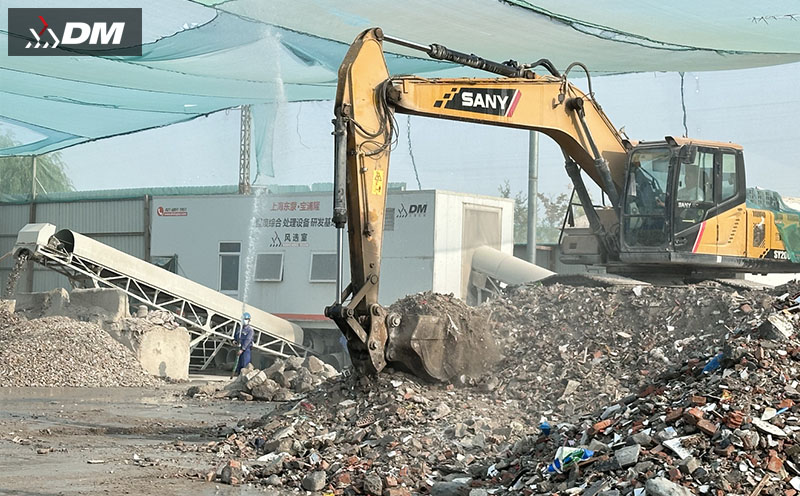
With the acceleration of Nigeria's urbanization process, core cities such as Lagos, Abuja, and Kano are undergoing large-scale renewal and transformation—intensive advancement of old urban area demolition, shantytown renovation, commercial complex construction, and affordable housing projects has led to an explosive growth in the total amount of construction and demolition (C&D) waste (concrete blocks, bricks, steel bars, gravel, etc.). Statistics show that major Nigerian cities generate over 5,000 tons of C&D waste daily, of which only 30% is simply landfilled, and 70% is randomly piled or discarded. This not only occupies a large amount of land resources (over 200 mu of land is landfilled annually in Lagos) but also causes environmental problems such as soil pollution, groundwater leakage, and dust diffusion, which is inconsistent with the Nigerian government's goals of promoting "green cities" and "circular economy." DongMeng has developed a targeted Construction and Demolition Waste Crushing System, focusing on "efficient recycling, resource regeneration, and environmental compliance" to convert C&D waste into high-quality recycled aggregates. It not only solves the problem of urban C&D waste disposal but also provides low-cost raw materials for infrastructure projects, becoming a "core driver" for Nigeria's urban sustainable development.
Core Value: Turning Waste into Treasure, Achieving Triple Sustainable Benefits
DongMeng's Construction and Demolition Waste Crushing System is not just a simple "crushing equipment" but an integrated full-process solution combining "sorting, crushing, screening, and purification." It achieves triple environmental, economic, and social benefits through resource regeneration, accurately matching Nigeria's urban development needs.
1. Environmental Sustainability: Reduction Treatment, Solving Pollution Dilemma
The system adopts a dual design of "source classification + end purification" to minimize the environmental impact of C&D waste: ① In the pre-treatment stage, AI visual sorting + magnetic separation combined technology is used to accurately separate steel bars (recovery rate ≥98%), plastics, wood, and other impurities, preventing harmful substances from entering recycled aggregates; ② The crushing process is equipped with a pulse dust collector + water mist dust suppression system, with dust emission concentration ≤10mg/m³, far lower than the 50mg/m³ standard stipulated by Nigeria's EPA (Environmental Protection Agency); ③ No wastewater discharge throughout the process, using a closed-loop water circulation system to treat cleaning wastewater, achieving 100% recycling; ④ The volume reduction rate of C&D waste exceeds 85%. Concrete blocks and bricks that originally needed to be landfilled are converted into recycled aggregates after treatment, significantly reducing landfills and environmental pollution—a system with a daily processing capacity of 500 tons can reduce landfill occupation by about 15 mu per year and carbon emissions by over 3,000 tons.
2. Economic Sustainability: Recycled Aggregate Substitution, Reducing Infrastructure Costs
Nigeria's natural aggregate resources are increasingly scarce, and transportation costs are high (aggregate procurement costs in remote areas reach 200,000 Naira/ton). Recycled C&D aggregates have become a cost-effective alternative. The recycled aggregates produced by DongMeng's system cover multiple specifications including 0-5mm (fine aggregates), 5-10mm, and 10-20mm (coarse aggregates), with quality fully complying with Nigeria's BS 8110 construction standard. They can be widely used in: ① Road base/subbase and sidewalk paving; ② Non-load-bearing structural walls of affordable housing and enclosures; ③ Aggregate blending in concrete mixing stations (blending ratio up to 30%); ④ Permeable pavement materials for squares and parking lots. Compared with natural aggregates, the procurement cost of recycled aggregates is reduced by 40%-60%. After adopting the system in an affordable housing project in Lagos, the monthly aggregate procurement cost was saved by over 12 million Naira, and the overall project cost was reduced by 15%.
3. Social Sustainability: Creating Jobs, Supporting Urban Renewal
The system is easy to operate and maintain, and can absorb local labor to participate in C&D waste sorting, equipment operation, daily inspections, and other work. A system with a daily processing capacity of 500 tons can directly create 15-20 jobs and indirectly drive employment in related industries such as transportation and spare parts supply. At the same time, the localized supply of recycled aggregates reduces the mining pressure on natural quarries, protects the ecological environment, and helps Nigeria achieve the goal of "synergistic development of urban renewal and ecological protection," gaining recognition from governments and environmental organizations in many regions.
Technical Core: Adapting to Nigerian Working Conditions, Achieving Efficient and Stable Operation
Targeting the characteristics of Nigerian C&D waste such as "complex composition (mixed concrete, bricks, steel bars), large moisture content fluctuations (up to 25% in the rainy season), and hot, humid, and dusty operating environments," the system has undergone special technical optimizations to ensure "strong adaptability, stable operation, and easy maintenance."
1. Intelligent Sorting and Crushing: Precisely Adapting to Complex C&D Waste
- AI Vision + Multi-Level Sorting: Equipped with high-definition cameras and AI recognition algorithms, it identifies non-metallic impurities (plastics, wood) in C&D waste within 0.5 seconds, and separates steel bars with magnetic separators. The sorting accuracy exceeds 95%, avoiding impurities affecting the quality of recycled aggregates;
- Flexible Crushing Technology: Adopts a combined process of "jaw crusher + impact crusher"—the jaw crusher performs primary crushing of large C&D waste (maximum feed particle size ≤800mm), and the impact crusher performs secondary crushing and shaping. By adjusting the crushing cavity type and speed, over-crushing is avoided, and the recycled aggregates have uniform gradation with a qualification rate of 98%;
- Anti-Clogging Design: Targeting the high moisture content of C&D waste in the rainy season, the crushing cavity is equipped with a high-frequency vibration anti-clogging device, the conveyor belt adopts an anti-slip cleaning structure, and the screening machine is equipped with a self-cleaning screen. It completely solves the problem of wall adhesion and clogging, and the screening efficiency is increased to 92%.
2. Localized Environmental Adaptation: Withstanding Hot, Humid, and Dusty Working Conditions
- Heat and Humidity Resistance Enhancement: The electrical system adopts IP67 waterproof and dustproof rating, and the equipment frame is sprayed with fluorocarbon anti-corrosion coating to resist 85% high humidity in southern coastal areas and erosion during the rainy season, extending the equipment service life by 30%;
- High Temperature Resistance Design: Equipped with a forced ventilation cooling system, the equipment operating temperature is ≤60℃ in a 45℃ high-temperature environment (northern dry and hot season) without overheating failures;
- Power Adaptation Optimization: Supports dual drive modes of grid power + diesel. Targeting the unstable power grid in some areas of Nigeria, it can switch to diesel drive to ensure continuous production without being affected by power outages.
3. Modular and Easy Maintenance: Reducing Operating Costs
- Modular Design: The crushing host, sorting equipment, and screening machine can be independently disassembled and maintained. Common spare parts (wear-resistant liners, screens, filters) are highly versatile and easy to purchase in the local market;
- Wear-Resistant Component Upgrade: The crushing cavity liner is made of high-chromium-molybdenum alloy, with a service life of 1200 hours, 50% longer than ordinary liners, reducing the frequency of spare part replacement;
- Simple Operation Interface: The central control screen supports bilingual operation in English/Hausa, real-time displaying equipment operation status, production capacity data, and fault warnings. Operators can work after simple training without professional technical background.
Nigerian Project Cases: Verifying Performance Across All Scenarios from Urban Demolition to Infrastructure Projects
DongMeng's Construction and Demolition Waste Crushing System has been successfully applied in multiple urban renewal projects in Nigeria, gaining customer recognition with stable performance and significant benefits.
Case 1: Lagos Old Urban Area Renewal Project — 500 Tons of C&D Waste Processed Daily
A demolition project in Lagos' old urban area generates 500 tons of C&D waste daily. The traditional disposal method is landfilling, which not only pollutes the environment but also incurs high transportation and landfilling costs. After the commissioning of DongMeng's Construction and Demolition Waste Crushing System: ① Processes 500 tons of C&D waste daily, producing 350 tons of recycled coarse aggregates (5-20mm) and 120 tons of recycled fine aggregates (0-5mm); ② The recycled aggregates are directly supplied to surrounding affordable housing projects for foundation backfilling and wall masonry, saving over 12 million Naira in monthly aggregate procurement costs; ③ The dust emission concentration is ≤8mg/m³, complying with EPA standards, winning recognition from the Lagos State Ministry of Environment and becoming a demonstration project for local urban C&D waste disposal.
Case 2: Abuja Affordable Housing Project — Localized Supply of Recycled Aggregates
An affordable housing project in Abuja needs to build 1,000 housing units, requiring 80,000 tons of aggregates. After adopting DongMeng's Construction and Demolition Waste Crushing System: ① Processes C&D waste generated from surrounding demolitions, producing 300 tons of recycled aggregates daily to meet the project's daily demand of 250 tons; ② The cost of recycled aggregates is only 40% of natural aggregates, reducing the total project aggregate procurement cost by 56%; ③ Reduces landfill occupation by about 12 mu and drives employment for 18 local residents, achieving a virtuous cycle of "construction - C&D waste disposal - employment."
Case 3: Kano State Road Renovation Project — Recycled Aggregates for Road Construction
A urban road renovation project in Kano State required a large amount of road base aggregates. DongMeng's system was used to process local C&D waste: ① The recycled aggregates met road construction standards after testing, used for road base paving with strength meeting C30 concrete requirements; ② Supplied 400 tons of recycled aggregates daily, shortening the aggregate transportation distance from 50km to 10km, reducing transportation costs by 70%; ③ Processed 60,000 tons of C&D waste during the project construction period, reducing carbon emissions by about 2,800 tons, helping Kano State achieve the goal of "green road construction."
Empowering Nigeria's Sustainable Development: More Than C&D Waste Disposal, Empowering Urban Future
Against the backdrop of Nigeria's accelerating urbanization and the promotion of "green infrastructure" policies, the resource utilization of C&D waste has become a key to urban sustainable development. DongMeng's Construction and Demolition Waste Crushing System, with technological innovation as the core, not only solves the problem of urban C&D waste pollution but also provides a low-cost, environmentally friendly aggregate solution for infrastructure projects, achieving the unification of "environmental, economic, and social benefits."
DongMeng has always been deeply rooted in the Nigerian market, adhering to the principles of "local adaptation, high efficiency and stability, and environmental compliance," continuously optimizing products and technologies to provide strong support for the renewal and development of cities such as Lagos, Abuja, and Kano. Choosing DongMeng's Construction and Demolition Waste Crushing System means choosing a "green path of resource regeneration," a "cost-controllable development model," and a "reliable partner adapted to local conditions." In the future, DongMeng will continue to work with Nigeria to empower urban sustainable development through technology and jointly build a clean, livable, and efficient modern city.
If you would like to get help immediately, you can also fill your requirements on the following form, we will contact you on the right time.


Get In Touch